 Get Directions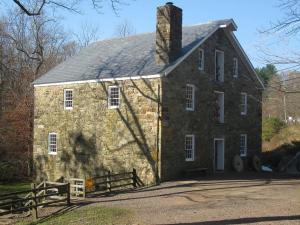
From the northwest corner of the parking area, proceed west to the stone Cooper Mill. The mill, built in 1826, is open for tours in the summer and on weekends in the...

From the northwest corner of the parking area, proceed west to the stone Cooper Mill. The mill, built in 1826, is open for tours in the summer and on weekends in the spring and fall. Descend the stairs alongside the mill and continue south on the blue-blazed spur of the Patriots’ Path (blazed with the path-and-tree logo), which crosses several tributary streams on wooden bridges and several wet areas on puncheons. About a third of a mile from the start, the trail turns left onto an abandoned railroad grade – the former route of the Hacklebarney Branch of the Central Railroad of New Jersey, built in 1873 to carry iron ore from mines along the river and abandoned in 1900. The trail follows this railroad grade for the next mile. Although it was abandoned over a century ago, the right-of-way is in remarkably good condition.
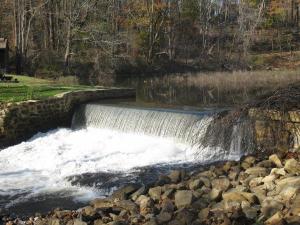
Half a mile from the start, you’ll pass Kay Pond (formerly known as Hacklebarney Pond) on the right. Here, the railroad had to be blasted through a rock cut, and the drill marks from the blasting may still be seen in the rock. The small building at the south end of Kay Pond was once used to store ice cut from the pond in the winter.
After passing the stone dam at the end of the pond, the trail goes by a bridge over the Black River (closed to vehicular traffic), turns left, and passes a fenced-in area on the left. This is the site of the former Hacklebarney Mine, where a considerable amount of iron ore was mined in the last quarter of the nineteenth century. The trail proceeds along the scenic river. Soon, the railroad grade ends and the trail continues on a slightly rougher footpath parallel to the river.
About 1.2 miles from the start, after crossing two wooden footbridges over tributary streams, the trail reaches abandoned concrete abutments in the river – the remnants of a former bridge. Here, the trail bears left and begins to head uphill on a wide woods road. It passes the start of the Green Trail on the right and bears left at the next fork (the right fork is the route of the Blue/Orange Trail). Soon, the trail begins to parallel Chubb Brook (below on the left). The trail now curves right and continues to climb more steeply.
At the top of the climb, the trail reaches a junction in a clearing, marked by signposts. Here, the Yellow Trail joins briefly. Turn left to continue on the Patriots' Path, then immediately turn left at the next intersection. After passing the start of the White Trail on the right, you'll continue along open fields and reach a parking area, with the Kay Environmental Center on the right.
Pass just to the left of the Environmental Center (note a Patriots' Path blaze on a tree to the left of a fence) and continue on a wide grassy path between fields, which becomes a grassy woods road. The Patriots' Path turns left at a T-intersection (the Orange Trail begins on the right), then bears right to join the paved entrance road. It continues along the road for a quarter mile, then turns right onto Pottersville Road. After following Pottersville Road for 750 feet, the trail turns left (opposite 230 Pottersville Road) and reenters the woods on a footpath. It continues through dense underbrush.
In another quarter mile, after bearing right at a junction, the trail begins a gradual climb of the hillside. After crossing an old woods road diagonallly to the left, it continues uphill on a rocky path, soon reaching the top of the hill. The trail now descends to a junction with the red-blazed Conifer Pass Trail (marked by signposts). Turn right and follow the red-blazed trail as it descends to recross Pottersville Road.
On the other side of the road, the trail descends through a mixed evergreen and deciduous forest, crossing several old stone walls along the way. At the base of the descent, it crosses Cedar Brook on rocks. The trail ascends rather steeply on switchbacks, continues climbing more gradually to the crest of the rise, then descends to the Black River, passing two mine pits on the right.
The red-blazed trail now heads north through the rocky gorge of the Black River, running directly along the river. This wild and spectacular section of the river is the scenic highlight of the hike, but the trail is narrow and runs along the steep hillside, so take care as you traverse this portion of the trail. This is a good place to take a break and enjoy the beauty of the cascading river.
After about a quarter of a mile, the trail begins to climb out of the gorge. At the top of the climb, it reaches a T-intersection. Here, the red-blazed trail turns right, but you should turn left, now following the Green Trail. The Green Trail descends on a woods road, passes a stone chimney and stone foundations on the left, and levels off along the river. Soon, it climbs to reach another T-intersection, where you should turn left, continuing to follow the Green Trail.
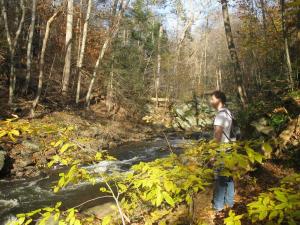
Once again, the trail descends to the river and continues along another wild and scenic section of the river, with cascades and rapids. Soon, you'll pass the stone abutments of a former bridge and reach a curved stone dam, with the ruins of a large stone building on the opposite side of the river.
Continue along the Green Trail, which soon begins to follow a level woods road. The Green Trail crosses the Orange Trail and continues to its terminus at the Patriots' Path. Turn left and follow the Patriots' Path north along the Black River for 1.2 miles, retracing your steps to the Cooper Mill parking area where the hike began.
Publication: Submitted by Daniel Chazin on 05/08/2003 updated/verified on 10/15/2020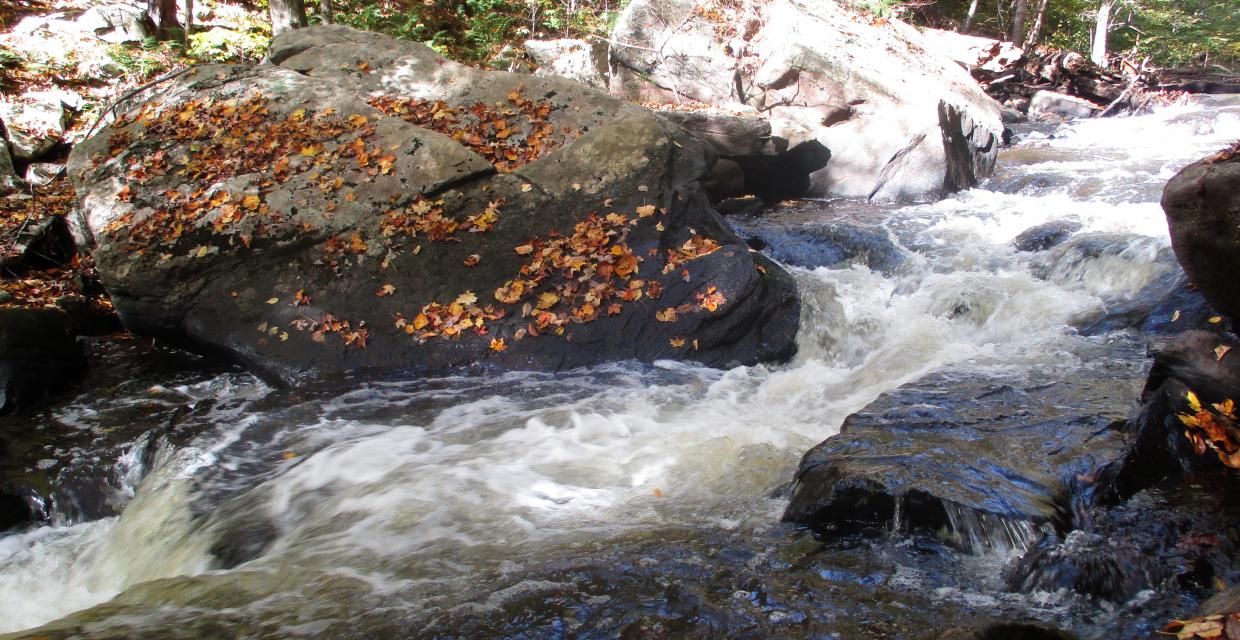

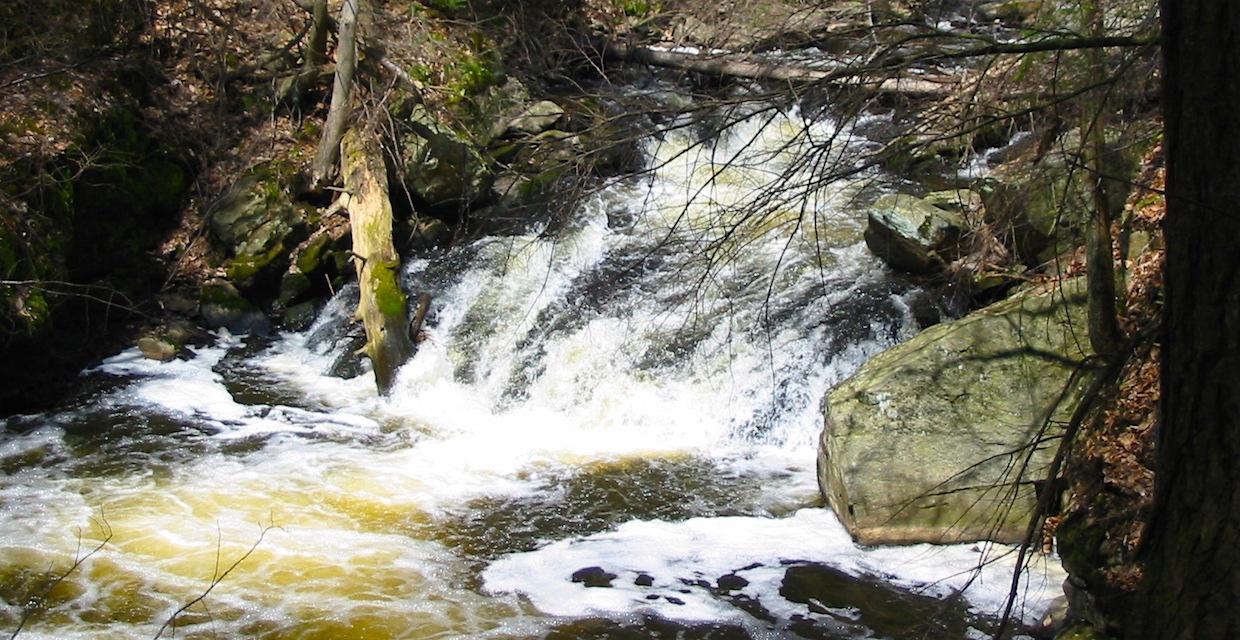

This lollipop-loop hike runs along the scenic Black River, following an abandoned railroad grade for part of the way and passing through a spectacular rocky gorge.
From the northwest corner of the parking area, proceed west to the stone Cooper Mill. The mill, built in 1826, is open for tours in the summer and on weekends in the...
Whether you are going for a day hike or backpacking overnight, it is good practice to carry what we call The Hiking Essentials. These essentials will help you enjoy your outing more and will provide basic safety gear if needed. There may also be more essentials, depending on the season and your needs.
Hiking Shoes or Boots
Water - Two quarts per person is recommended in every season. Keep in mind that fluid loss is heightened in winter as well as summer. Don't put yourself in the position of having to end your hike early because you have run out of water.
Map - Know where you are and where you are going. Many of our hiking areas feature interconnecting network of trails. Use a waterproof/tear-resistant Tyvek Trail Conference map if available or enclose your map in a Ziplock plastic bag. If you have a mobile device, download Avenza’s free PDF Maps app and grab some GPS-enhanced Trail Conference maps (a backup Tyvek or paper version of the map is good to have just in case your batteries die or you don't have service). Check out some map-reading basics here.
Food - Snacks/lunch will keep you going as you burn energy walking or climbing. Nuts, seeds, and chocolate are favorites on the trail.
Sunscreen and insect repellent
Rain Gear and Extra Clothing - Rain happens. So does cold. Be prepared for changing weather. Avoid cotton--it traps water against your skin and is slow to dry. If you are wearing wet cotton and must return to your starting point, you risk getting chills that may lead to a dangerous hypothermia. Choose synthetic shirts, sweaters and/or vests and dress in layers for easy on and off.
Compass - A simple compass is all you need to orient you and your map to magnetic north.
Light - A flashlight or small, lightweight headlamp will be welcome gear if you find yourself still on the trail when darkness falls. Check the batteries before you start out and have extras in your pack.
First Aid Kit - Keep it simple, compact, and weatherproof. Know how to use the basic components.
Firestarter and Matches - In an emergency, you may need to keep yourself or someone else warm until help arrives. A firestarter (this could be as simple as leftover birthday candles that are kept inside a waterproof container) and matches (again, make sure to keep them in a waterproof container) could save a life.
Knife or Multi-tool - You may need to cut a piece of moleskin to put over a blister, repair a piece of broken equipment, or solve some other unexpected problem.
Emergency Numbers - Know the emergency numbers for the area you're going to and realize that in many locations--especially mountainous ones, your phone will not get reception.
Common Sense - Pay attention to your environment, your energy, and the condition of your companions. Has the weather turned rainy? Is daylight fading? Did you drink all your water? Did your companion fail to bring rain gear? Are you getting tired? Keep in mind that until you turn around you are (typically) only half-way to completing your hike--you must still get back to where you started from! (Exceptions are loop hikes.)
Check the weather forecast before you head out. Know the rules and regulations of the area.
Travel and Camp on Durable Surfaces
Be Considerate of Other Visitors
The Trail Conference is a 2015 Leave No Trace partner.
(c) Leave No Trace Center for Outdoor Ethics: www.LNT.org.
Take I-80 West to Exit 27A and continue south on U.S. Route 206 for 8.0 miles. Turn right onto County Route 513 and follow it for 1.2 miles to the entrance to Cooper Mill Park, on the left side of the road.

 Directions to Trailhead
 Public Transportation
 Support the trails with a donation!