Catfish Loop Trail

Overview This loop hike traverses a remote area of the park, reaching an interesting rock formation with broad west-facing views and passing many old stone walls.
DetailsTime:
3.5 hours
Difficulty:
Easy to Moderate
Length:
4.9 miles
Features:
Views
Dogs:
Allowed on leash
LocationPark:
Region:
State:
NY
County:
Putnam
MapBuy Trail Map:
PublicationDate:
03/23/2007
Submitter:Daniel Chazin

Driving Directions

Take the Palisades Interstate Parkway to its northern terminus at the Bear Mountain Bridge. Cross the bridge and proceed north on N.Y. Route 9D for 8.0 miles to Peekskill Road at the southern end of Cold Spring (just beyond the Boscobel Restoration). Turn right and follow Peekskill Road for 0.5 mile to its terminus at a junction with N.Y. Route 301, then turn right and follow Route 301 for 4.6 miles to its intersection with Dennytown Road. Turn right onto Dennytown Road and continue for 1.2 miles to a large dirt parking area on the left side of the road.

Description

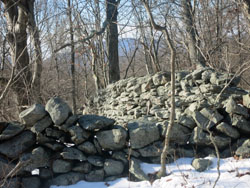
Find the white-blazed Appalachian Trail (A.T.) at the southern end of the parking area and proceed east on the A.T. (do not cross Dennytown Road). The trail descends into the woods and parallels a stone wall on the left. You will observe many stone walls – which indicate that the area was once used for agricultural purposes – in a number of locations along the hike.

In a quarter of a mile, after crossing the stone wall and passing a wetland to the left, you’ll reach a T-intersection. The A.T. turns left, but you should turn right and continue on the red-blazed Catfish Loop Trail, which begins here. You will be following the Catfish Loop Trail for its entire 3.6-mile length.

The Catfish Loop Trail cuts through a dense barberry thicket, crosses Dennytown Road diagonally to the left, and re-enters the woods, descending gently. After crossing two streams, the trail begins a steady climb, and it passes a register box on a tree to the right of the trail (please sign the register). It crosses another stream and follows along the park boundary (marked by “posted” signs to the left of the trail) for some distance. Soon, it reaches the highest point on this section of the ridge, which is marked by a cairn.

After a relatively level stretch, the Catfish Loop Trail crosses the white-blazed A.T. (this junction is also marked by a cairn). The trail now descends steadily through mountain laurel thickets. It crosses a woods road (blazed yellow as a horse trail) and, a short distance beyond, crosses a stream on rocks. Signs here indicate that, to the right, the area is closed to protect a wildlife habitat.

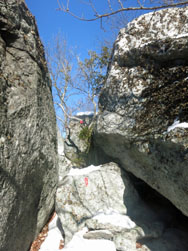
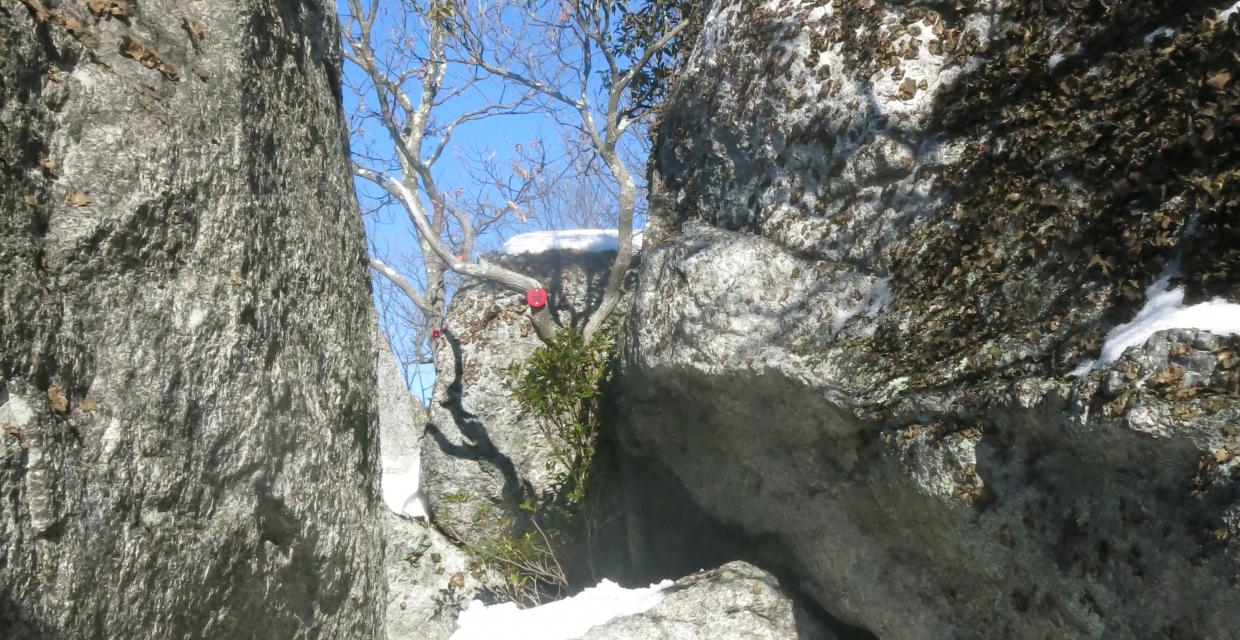
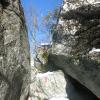
After a gradual climb, the trail reaches the most interesting point on the hike, where it goes through a narrow passage between large lichen-covered boulders. From the top of the boulders to the right there is a panoramic west-facing view, with Crows Nest and Storm King Mountains visible on the west side of the Hudson River. You’ve now hiked for about two miles, and this attractive spot Is a good place to take a break.
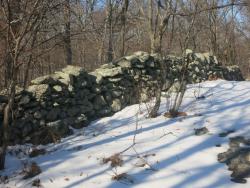
Continue ahead on the Catfish Loop Trail, which descends through mountain laurel, climbs a rock outcrop, then descends steeply. The trail crosses several more rock outcrops and passes through dense mountain laurel thickets. After going by a cliff to the left, the trail bends sharply to the right and begins to head north on a relatively level footpath.

Nearly three miles into the hike, the trail crosses a stream and goes through a gap in a stone wall. It now begins to climb, following a rock outcrop that overlooks a valley to the left. You’ll notice an abundance of rock walls near the trail in this area, and it is hard to believe that this land that appears so inhospitable to settlement was once devoted to agricultural pursuits. There are several limited west-facing viewpoints along this section of the trail, with the West Hudson Highlands visible in the distance.

Soon, the trail begins to parallel a stone wall on the left, which marks the park boundary (note the “posted” signs on the opposite side of the wall). After a while, the blazes bear right, away from the wall. A short distance beyond, be alert as the blazed trail turns sharply right (do not follow an unmarked trail that continues straight ahead).

The trail now crosses a stream and continues through dense mountain laurel thickets. After some short ups and downs, you will notice Duck Pond through the trees to the left. The trail makes a very sharp bend and nearly doubles back on itself, heading south and then east, and reaching a large rock outcrop with a view of the valley below to the left.
The Catfish Loop Trail descends steeply from the outcrop and ends in the valley below. Signs indicate that the trail to the right is closed to protect a wildlife habitat, but you should continue ahead on the distinct footpath, now following the blue blazes of the Three Lakes Trail (which begins here).
The Three Lakes Trail crosses a wide stream on rocks, goes over a minor rise, then begins a steep, steady climb of about 150 vertical feet. Upon reaching the crest of the ridge, the trail goes down a little, regains the lost altitude and levels off. A short distance beyond, you’ll pass another trail register box on the right side of the trail (please sign).

Soon, the trail crosses a yellow-blazed woods road. This is the same horse trail that you crossed earlier in the hike. The Three Lakes Trail now climbs briefly to a rock outcrop, descends steadily through the woods, and climbs once more to reach to junction with the white-blazed Appalachian Trail, which comes in from the right. Turn left and follow the joint Three Lakes Trail/A.T. for a short distance to reach Dennytown Road. The parking area where the hike began is on the opposite side of the road.