
 Get Directions
From the parking area, walk south on Route 9W for a few hundred feet (there are trail blazes along the roadwalk). Just beyond road signs for Routes 9W and 202, you'll see three blue blazes and three red-dot-on-white blazes on a tree adjacent to the road. These blazes mark the start of the Timp-Torne (blue) and Ramapo-Dunderberg (red-dot-on-white)...
Hike Description:
From the parking area, walk south on Route 9W for a few hundred feet (there are trail blazes along the roadwalk). Just beyond road signs for Routes 9W and 202, you'll see three blue blazes and three red-dot-on-white blazes on a tree adjacent to the road. These blazes mark the start of the Timp-Torne (blue) and Ramapo-Dunderberg (red-dot-on-white) trails. You'll be following the Timp-Torne Trail for the first part of the hike and returning on the Ramapo-Dunderberg Trail.
Follow the blue and red-dot-on-white blazes into the woods along a level footpath through an area of tangled vines. Soon, the trail will bear left and climb stone steps, and you'll reach a stone-arch tunnel, below on the left. This tunnel is a remnant of the Dunderberg Spiral Railway, the construction of which commenced in 1890. The plan was to have the rail cars pulled up the mountain on a cable incline by a stationary steam engine, with the downhill journey being made by gravity. Large sums were spent on the project, two tunnels were partially completed, and much of the line was graded, but the promoters ran out of funds, and the railway was never finished. The tunnel you see on the left was designed to allow the ascending trains to pass over the route of the descending trains.
The trail now bears right and ascends more steeply on switchbacks and stone steps. At the top of the climb, you'll reach a junction. Here, the red-dot-on-white blazes continue ahead, while the blue blazes turn left. Follow the blue blazes of the Timp-Torne Trail, which head southwest, parallel to the river. The trail continues to climb, but on a more moderate grade. Soon, views of the river appear through the trees.
In another quarter mile, the trail turns right and heads away from the river. After going through a rocky area on switchbacks, you'll arrive at a graded section of the railway. Follow the blue blazes as they turn left and continue along this level, graded embankment for the next quarter mile. With the railbed ahead blocked off by a fallen tree, the trail turns right and climbs to the next higher level, where it turns left. Just ahead, on the right, you'll come to the portal of an unfinished tunnel, intended for use by the descending trains.
The trail now returns to the lower level of the graded railway, which it follows around a curved embankment, with views through the trees over the Hudson River. The curved roadbed ends at the opposite end of the uncompleted tunnel, but the trail bears left, crosses a stream and then a woods road, and climbs to another limited viewpoint through the trees, looking south along the river. Beyond the viewpoint, the trail is relatively level, and even descends a little.
Watch for a very sharp right turn in the trail, which reverses direction and heads northeast on a switchback, uphill at first. After another level stretch, the trail reaches a panoramic viewpoint, looking south along the Hudson. and the New York City skyline may be seen in the distance to the south on a clear day. Just ahead, you'll come to another viewpoint, with the City of Peekskill visible on the right, and the ridge of Dunderberg Mountain straight ahead.
From this viewpoint, the trail again reverses direction and heads southwest on a relatively level footpath. After passing another panoramic viewpoint that looks south along the Hudson, the trail climbs gradually over undulating terrain, with cairns (piles of rocks) marking the way in places. From the crest of the rise, there are views through the trees of the ridge to the north, which will be your return route. The trail now begins a steady descent, with rock steps provided along one steep section. At the base of the descent, the trail intersects a woods road, with the junction marked by a small cairn.
Turn right here, leaving the blue-blazed Timp-Torne Trail, and follow the woods road, which is blazed with white "1777" blazes, commemorating the use of this road by the British in their attack on Fort Montgomery during the Revolutionary War. You'll be following this road for only about two or three minutes. When you see the red-dot-on-white blazes of the Ramapo-Dunderberg Trail crossing the road, turn right and follow these blazes. You'll be following the red-dot-on-white blazes for the remainder of the hike.
The Ramapo-Dunderberg Trail climbs to a viewpoint from open rocks, with Bear Mountain (identified by the stone tower on its summit) visible ahead (through the trees), and Bald Mountain to the right. The trail continues over a rise through dense mountain laurel thickets, then descends to briefly join a woods road that crosses a stream, with a stone fireplace on the right just beyond the stream crossing. Follow the red-dot-on-white blazes as the trail bears left and begins to climb Bald Mountain.
After a level section, the trail climbs to the summit ridge, which it reaches at a southwest-facing viewpoint. The trail continues along the ridge, then makes its final climb to the summit of Bald Mountain, turning sharply right just before reaching the 1,115-foot summit. A rock outcrop just north of the summit offers a panoramic view to the north over the Hudson River, Iona Island and the Bear Mountain Bridge. You've now gone a little more than halfway (and have finished nearly all of the climbing), so this is a good place to take a break.
When you're ready to continue, return to the trail, and be sure to take the left fork. The trail begins to descend, passing an opening of the Cornell Mine on the left. At the base of the descent, the blue-blazed Cornell Mine Trail leaves to the left. Continue ahead on the Ramapo-Dunderberg Trail, which follows the ridge of Dunderberg Mountain, with several ups and downs.
About a mile from the junction with the Cornell Mine Trail, the Ramapo-Dunderberg Trail briefly joins a woods road, crosses a completed grade of the Dunderberg Spiral Railway, and climbs to a high point. After a slight descent, it climbs steeply to reach a limited west-facing viewpoint. Continue along the ridge of Dunderberg Mountain, passing through thickets of dense birch saplings.
After descending from the ridge, steeply in places, you'll notice a viewpoint from a rock outcrop just to the right of the trail, with Peekskill directly across the river. A short distance beyond, as the trail curves to the right, a short white-blazed trail leads ahead to another viewpoint. The trail soon joins another graded section of the railbed, with several gaps where the grading was never finished, and passes more views over the Hudson River.
At a stone abutment (built to carry the cars going up the mountain), the trail turns sharply left and descends steadily along the right-of-way excavated for the cable incline. After about ten minutes, you'll reach a junction with the blue-blazed Timp-Torne Trail. Continue ahead, following both blue and red-dot-on-white blazes back to the parking area where the hike began.
Publication: Submitted by Daniel Chazin on 12/12/2002 updated/verified on 11/23/2022
This loop hike follows portions of the never-completed Dunderberg Spiral Railway, climbs to the summit of Bald Mountain, and passes several expansive viewpoints over the Hudson River.
41.281137, -73.962838
Rockland Co., NY
7 mi
5.5 hrs

Buy Book: Circuit Hikes in Harriman
Avenza App Map: Harriman-Bear Mountain 119
Hike Checklist:
Whether you are going for a day hike or backpacking overnight, it is good practice to carry what we call The Hiking Essentials. These essentials will help you enjoy your outing more and will provide basic safety gear if needed. There may also be more essentials, depending on the season and your needs.
The Essentials
Hiking Shoes or Boots
Water - Two quarts per person is recommended in every season. Keep in mind that fluid loss is heightened in winter as well as summer. Don't put yourself in the position of having to end your hike early because you have run out of water.
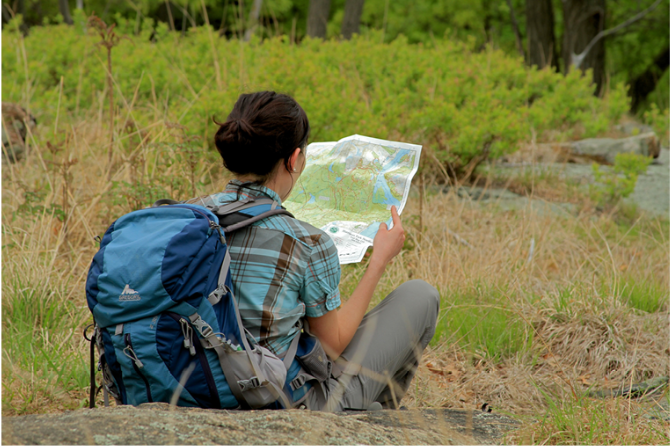
Map - Know where you are and where you are going. Many of our hiking areas feature interconnecting network of trails. Use a waterproof/tear-resistant Tyvek Trail Conference map if available or enclose your map in a Ziplock plastic bag. If you have a mobile device, download Avenza’s free PDF Maps app and grab some GPS-enhanced Trail Conference maps (a backup Tyvek or paper version of the map is good to have just in case your batteries die or you don't have service). Check out some map-reading basics here.
Food - Snacks/lunch will keep you going as you burn energy walking or climbing. Nuts, seeds, and chocolate are favorites on the trail.
Sunscreen and insect repellent
Rain Gear and Extra Clothing - Rain happens. So does cold. Be prepared for changing weather. Avoid cotton--it traps water against your skin and is slow to dry. If you are wearing wet cotton and must return to your starting point, you risk getting chills that may lead to a dangerous hypothermia. Choose synthetic shirts, sweaters and/or vests and dress in layers for easy on and off.
Compass - A simple compass is all you need to orient you and your map to magnetic north.
Light - A flashlight or small, lightweight headlamp will be welcome gear if you find yourself still on the trail when darkness falls. Check the batteries before you start out and have extras in your pack.
First Aid Kit - Keep it simple, compact, and weatherproof. Know how to use the basic components.
Firestarter and Matches - In an emergency, you may need to keep yourself or someone else warm until help arrives. A firestarter (this could be as simple as leftover birthday candles that are kept inside a waterproof container) and matches (again, make sure to keep them in a waterproof container) could save a life.
Knife or Multi-tool - You may need to cut a piece of moleskin to put over a blister, repair a piece of broken equipment, or solve some other unexpected problem.
Emergency Numbers - Know the emergency numbers for the area you're going to and realize that in many locations--especially mountainous ones, your phone will not get reception.
Common Sense - Pay attention to your environment, your energy, and the condition of your companions. Has the weather turned rainy? Is daylight fading? Did you drink all your water? Did your companion fail to bring rain gear? Are you getting tired? Keep in mind that until you turn around you are (typically) only half-way to completing your hike--you must still get back to where you started from! (Exceptions are loop hikes.)
Check the weather forecast before you head out. Know the rules and regulations of the area.
The Leave No Trace Seven Principles
Plan Ahead and Prepare
- Know the regulations and special concerns for the area you'll visit.
- Prepare for extreme weather, hazards, and emergencies.
- Schedule your trip to avoid times of high use.
- Visit in small groups when possible. Consider splitting larger groups into smaller groups.
- Repackage food to minimize waste.
- Use a map and compass to eliminate the use of marking paint, rock cairns or flagging.
Travel and Camp on Durable Surfaces
- Durable surfaces include established trails and campsites, rock, gravel, dry grasses or snow.
- Protect riparian areas by camping at least 200 feet from lakes and streams.
- Good campsites are found, not made. Altering a site is not necessary.
- In popular areas:
- Concentrate use on existing trails and campsites.
- Walk single file in the middle of the trail, even when wet or muddy.
- Keep campsites small. Focus activity in areas where vegetation is absent.
- In pristine areas:
- Disperse use to prevent the creation of campsites and trails.
- Avoid places where impacts are just beginning.
- Pack it in, pack it out. Inspect your campsite and rest areas for trash or spilled foods. Pack out all trash, leftover food and litter.
- Deposit solid human waste in catholes dug 6 to 8 inches deep, at least 200 feet from water, camp and trails. Cover and disguise the cathole when finished.
- Pack out toilet paper and hygiene products.
- To wash yourself or your dishes, carry water 200 feet away from streams or lakes and use small amounts of biodegradable soap. Scatter strained dishwater.
- Preserve the past: examine, but do not touch cultural or historic structures and artifacts.
- Leave rocks, plants and other natural objects as you find them.
- Avoid introducing or transporting non-native species.
- Do not build structures, furniture, or dig trenches.
- Campfires can cause lasting impacts to the backcountry. Use a lightweight stove for cooking and enjoy a candle lantern for light.
- Where fires are permitted, use established fire rings, fire pans, or mound fires.
- Keep fires small. Only use sticks from the ground that can be broken by hand.
- Burn all wood and coals to ash, put out campfires completely, then scatter cool ashes.
- Observe wildlife from a distance. Do not follow or approach them.
- Never feed animals. Feeding wildlife damages their health, alters natural behaviors, and exposes them to predators and other dangers.
- Protect wildlife and your food by storing rations and trash securely.
- Control pets at all times, or leave them at home.
- Avoid wildlife during sensitive times: mating, nesting, raising young, or winter.
Be Considerate of Other Visitors
- Respect other visitors and protect the quality of their experience.
- Be courteous. Yield to other users on the trail.
- Step to the downhill side of the trail when encountering pack stock.
- Take breaks and camp away from trails and other visitors.
- Let nature's sounds prevail. Avoid loud voices and noises.
The Trail Conference is a 2015 Leave No Trace partner.
(c) Leave No Trace Center for Outdoor Ethics: www.LNT.org.
 Directions to Trailhead
 Public Transportation
Directions to Trailhead :
Take the Palisades Interstate Parkway to its northern terminus at the Bear Mountain Circle and proceed south on U.S. Route 9W for about four miles. At the base of a downhill section of the road, as the road reaches the river level, you’ll notice a large parking area on the right side of the road. (A side road, River Road to Jones Point, leaves sharply to the left here.) Park in this gravel parking area.
TRAIN TRANSPORT :
Not availableBUS TRANSPORT :
Not availableShare Your Experience
SUPPORT
 Support the trails with a donation!
Trail Conference volunteers maintain trails in this hike.
Trip Reports
rate experience September 02, 2019
Not My Favorite Hike In Harriman, But Worth Doing At Least Once
I didn't enjoy many sections of this hike, especially the descent on the R-D Trail, but there were some nice views in spots. Getting stung by a Yellowjacket probably didn't help my disposition. Directions here are accurate, although I would advise doing the route in reverse- that's the way I'll do it if there's a next time, and I think it will be more enjoyable not having to descend on the loose rocks of the R-D. There might be more views in fall when the leaves are off the trees.
Note that when I finished (around 1:00 PM), the parking area was full, and there were cars waiting for people to leave so they could park. Probably not an issue if you do this during the week, but if going on a weekend, plan to start early.
August 29, 2017
Wonderful Hike
I walked this hike yesterday by myself and didn't see another soul. Peaceful, challenging, perfect. Reading the description of the trail on this site really added to the pleasure as I am not a great map reader...people who have hiked with me will call that an understatement. But I am getting better. My husband was very good at mapping out hikes and we spent many days hiking in Harriman. He passed away 2 years ago and this was my first time back. I left some of his ashes at the trail head and at the suggested lunch spot looking toward Bear Mountain. Know that your joy in spending time on the trails in that special state of mind either alone or with other hikers would be a great delight for him. I was happy all day.
August 21, 2015
Try the Hike in Reverse
<p>I went up the RD this morning,as it is more exposed to the sun, and came back on the TT, which had more shade and less ups and downs. I also extended the hike to the Timp, making a 10 mile loop. I started at 10:00, reached Bald Mt just after 11:00 and reached the Timp for lunch at 12:15. I was back at my car at 2:15 and drank about 2 quarts of water. I didn't hike fast, but steady with almost no stops. I found the downs hard on my knees,even though I used trekking poles, but I am 62. I had some breeze today and rain cooled things down overnight, otherwise I would start earlier in the summer. Dunderberg had fires 20 years ago and the RD was much more exposed some years back, but the new growth provided shade most of the time.</p>