
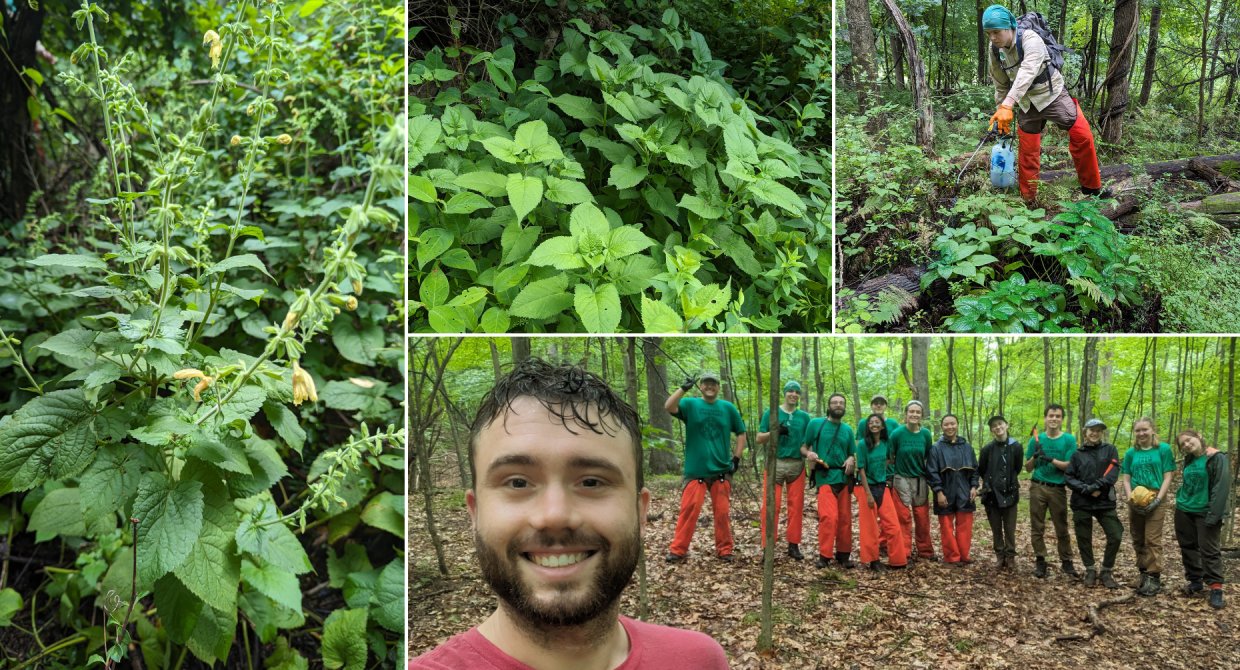
Sticky sage (Salvia glutinosa, glutinous sage, Jupiter’s sage, Jupiter’s distaff), an emerging invasive species in the Lower Hudson Valley, is a nemesis of Ryan L. McClean, the Terrestrial Invasive Species Project Manager for the New York-New Jersey Trail Conference (Trail Conference) under the Lower Hudson Partnership for Regional Invasive Species Management (LH PRISM). Sticky sage is an herbaceous perennial plant in the mint family native to Europe. Like many invasives in our region, sticky sage is sold as an ornamental garden plant and has recently been observed exhibiting invasive characteristics in multiple New York locations (see here for species ID). This species tolerates a wide range of sun exposure and soil moisture conditions and can reproduce via sticky seeds hitchhiking on animals and hikers, and also underground via clonal root reproduction. Because of the robust nature of sticky sage, the ease of spread, and the avoidance of deer herbivory and other predation, sticky sage can form monocultures on forest floors. These monocultures push out native plants, causing a cascading reduction of biodiversity and ecosystem health. Since everything humans need and love comes from nature, this has huge implications for human health as well.
There are only three known infestations of sticky sage in New York State. Because of the low number of infestations and the devastating potential impacts of this species, it is classified as a Tier 2 emerging invasive species with the goal of regional (and statewide) eradication. One infestation is in the Finger Lakes region, and Ryan McClean alerted their peers in the FL PRISM of the infestation. This year, it was surveyed (and found to be quite extensive across 17 acres) and management efforts began. A second infestation is located in Westchester County on a small private property. The site was first visited in 2017 when 210 plants were removed. Pulling yearly, less and less sticky sage was found until finally, no sticky sage was found at this site in 2022. The site was monitored again in 2023 and there was no sticky sage present! As a new invasive species, there is not much information available about sticky sage’s ecology, including seed bank longevity. Not finding sticky sage at this infestation two years in a row after five years of management has huge implications for sticky sage management; the seeds in the soil may no longer germinate after five years!