Trail Conference
Conservation Dogs Program
CDP Home | Our Work | About Us | Get Involved | FAQs | Surveyor Portal
Conservation Dogs Program FAQs
Does the Trail Conference own the dogs?
The dogs are owned by their handlers, but the Trail Conference supports them through a monthly care stipend.
What type of dog can be a conservation detection dog?
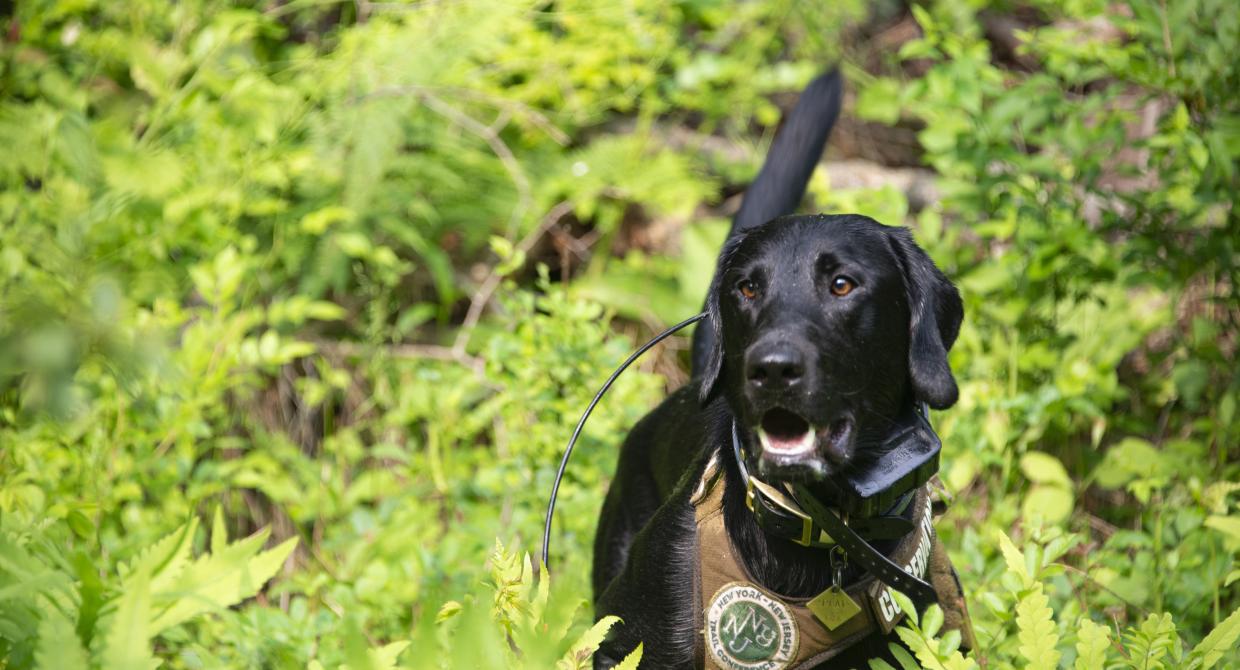
Across the world, a variety of dogs are trained for conservation detection work, with many of them being discovered in shelters, giving these dogs not just a home, but a dream job. While labradors, border collies, springer and cocker spaniels, cattle dogs, Belgian malinois, and German shepherds are commonly seen in this field, success isn’t about the breed. The top-performing dogs share a few key traits: an intense motivation for toys or food, often to the point of obsession, the ability to ignore wildlife, a strong work ethic, and intrinsic joy for searching and working with a handler. Physical fitness is also essential, as the job demands high stamina and structural soundness. Even dogs with all the right qualities may not take to the role, but for the right dog, it’s truly a dream job.
Who takes care of the dogs when they’re off duty?
The dogs live with and are cared for by their handlers. When they’re off duty, they are part of their handler’s families and are loved deeply!
How do the dogs know what they’re supposed to be finding?
We like to focus on a single project for a stretch of time, so the dogs have recent reinforcement for finding the target species we hope to find on a given day. Sometimes our surveys require the dogs to use different search strategies to be successful, and, therefore, focusing on one project for a stint of time instead of bouncing between projects is helpful. For example, some species we work on have very small amounts of odor, and the dogs must search slowly and methodically, versus other projects where the target is rather stinky and the dogs can cover large areas of land at a faster pace. However, every target we’ve taught the dogs to detect means the same thing to them: BALL! For this reason, if we were to encounter one target while we were intentionally searching for another, we expect (and have had!) our dogs to alert us to it.
Where Do You Work?
We primarily operate in northern New Jersey and the lower Hudson Valley in New York. By focusing on a specific geographic area, we’re able to fully support the needs of our local nonprofit and state agency partners. This allows us to work on ongoing projects, year after year, and see results by leveraging our organization’s volunteer power and staff expertise.
That said, we’re open to working beyond this area, especially if a partner needs help preventing the spread of an invasive species near our current region, or if they request assistance with detecting a species our dogs are already trained to find.
How long does it take to train the dogs?
Initially, training the dogs in the game of detection can take multiple weeks or even months, depending on the dog. But once the dog knows the concept of “search, locate, alert”, they can learn a new target odor in a matter of days! However, additional training—often lasting several weeks—is required to achieve the performance standard necessary for deployment. This training also ensures that the dogs are in peak physical condition and can safely perform their duties. We prioritize both their physical fitness and safety to ensure they are fully prepared for mission readiness.
I’m interested in pursuing a career as a conservation detection dog handler. How do I get started?
We recommend joining the Conservation Dog Alliance to connect with a community of experts, handlers, trainers, biologists, and enthusiasts who are active in this field. The Alliance offers valuable networking opportunities and continued education resources that can guide you in the right direction as you pursue your career.
How many species can a dog work on?
There is no limit to the number of different odors a dog can learn to detect! The number of targets we teach a single dog depends on many factors, including the dog’s experience level, the search strategy required to find a particular target, and potential overlap of target habitats.
How do you train the dogs?
We train dogs by pairing a target scent (plant, animal, etc) with a reward-usually a toy. When the dog detects the scent, they get to play! This process, called “imprinting” or “creating odor relevancy,” helps the dog understand that the target scent is important. Training for detection work involves three main steps: 1. Search: The dog uses their nose to explore and find the scent. As they search, they learn how to navigate different terrains, interpret air currents and wind patterns, and handle environmental challenges like wildlife distractions or tight spaces. 2. Locate: The dog pinpoints the source of the odor. 3. Alert: Once they find the scent, the dog performs a trained behavior, such as sitting or freezing, to signal the find. We typically teach the alert separately, then combine all three steps—search, locate, and alert—into one process. The dog is rewarded after completing the full sequence, making the work both fun and rewarding for them!
Do you have any internship or volunteer opportunities available?
Thank you for your interest in getting involved! Please visit Volunteer Positions for current volunteer opportunities. Specific internship and volunteer positions for our program will be posted there, as well as on our Instagram page. We’re always grateful for those who want to contribute to our mission!
How can I help support the work you’re doing?
We truly appreciate your interest in supporting our mission! There are several ways you can help: by making a donation, visiting our Amazon Wishlist to contribute specific items we need, or volunteering your time to assist with our projects. Your support means the world to us and makes a huge difference in our efforts to protect wildlife and the environment!
Follow Our Journey

Follow us on Instagram
for photos and field updates

Visit our Amazon Wishlist
to support the dogs

Watch us on YouTube
for conservation stories